The Complete Guide to ADHD Time Management for Adults
Mar 28, 2026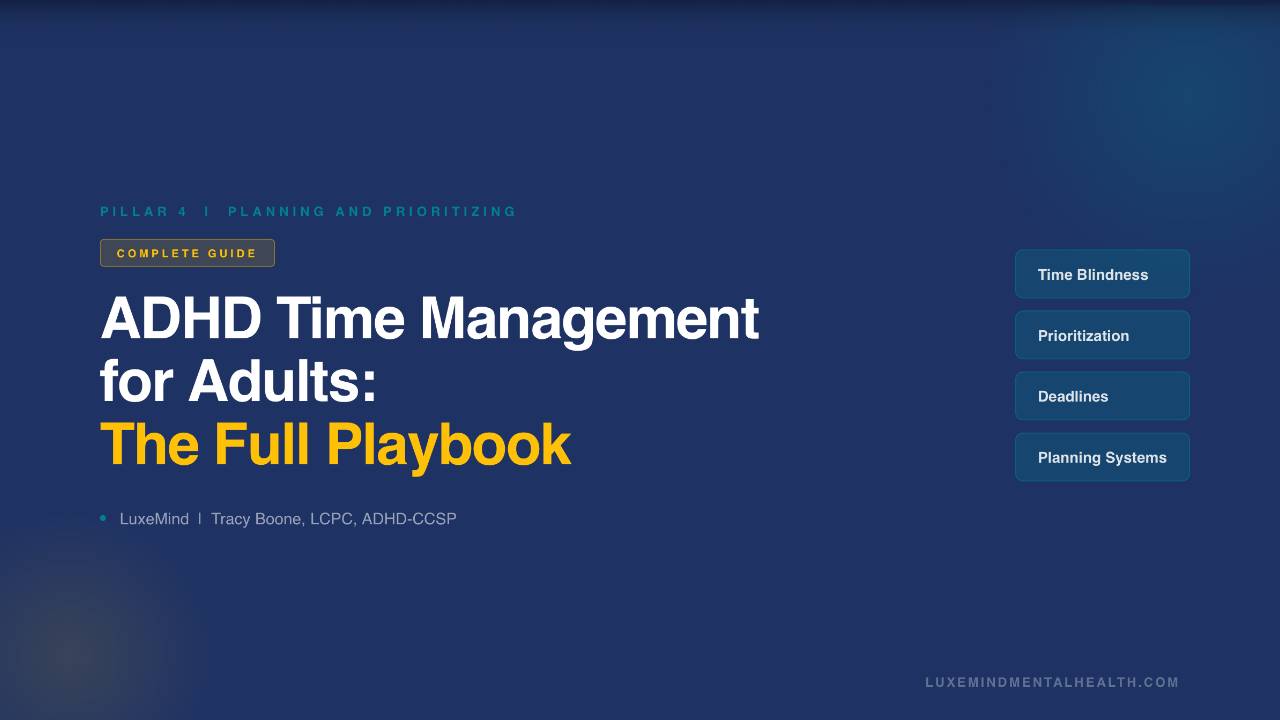
Time management is the number one complaint I hear from adults with ADHD. Not focus. Not motivation. Time.
And it makes sense. Because time management is not one skill. It is a collection of executive functions working together, and for ADHD brains, executive functions are the exact thing that does not work on demand.
This guide covers everything. Why time management is hard for ADHD brains, what is actually happening neurologically, and the specific tools and strategies that produce real results for real adults with ADHD.
If you have ever missed a deadline you cared about, lost two hours to a task that felt like twenty minutes, or sat frozen in front of your to-do list unable to choose where to start, this guide was written for you.
Why Time Management Is Different With ADHD
Most time management advice assumes your brain works a certain way. It assumes you can look at a list of tasks, assess their importance, choose the most urgent one, and start working on it. It assumes that knowing a deadline is coming is enough to motivate action before the last possible moment. It assumes that if you write something down in a planner, you will remember to look at the planner.
For ADHD brains, none of those assumptions are reliable.
ADHD affects the prefrontal cortex, the part of the brain responsible for planning, prioritization, working memory, impulse control, and time perception. These are not character traits. They are neurological functions. When they are inconsistent, which is the nature of ADHD, the entire scaffolding that typical time management advice is built on becomes unreliable.
This is not a motivation problem. It is not a discipline problem. It is a brain-based difference in how time is perceived, how priorities are registered, and how action gets initiated. Understanding that distinction is the starting point for building a system that actually works.
The Four Biggest Time Management Challenges for ADHD Adults
Each of the posts in this series goes deep on one specific challenge. Here is the overview of all four, and why they matter.
Time Blindness
The ADHD brain does not experience time as a continuous flow. It experiences now, and not now. Something is either happening in front of you right now, or it exists in a vague, not-yet-real future. This is called time blindness, and it explains why a deadline that is two weeks away carries no urgency until it is suddenly two days away.
Time blindness is not about being careless with time. It is a genuine neurological difference in how the brain perceives the passage of time. The solution is not to try harder to feel time. The solution is to make time visible through external tools.
Read the full post: Why ADHD Adults Struggle With Time Blindness
Prioritization
When every task on your list feels equally urgent and equally overwhelming, your brain cannot generate a clear starting point. This is not disorganization. It is what happens when the executive functions responsible for sorting, ranking, and selecting tasks are running inconsistently.
ADHD adults often describe their to-do list as looking completely flat. Nothing rises to the top naturally. Everything demands attention at the same volume. The solution is an external filtering system that removes the decision from the moment and replaces it with a simple structure.
Read the full post: Why ADHD Adults Can't Prioritize and What to Do About It
Deadlines and Urgency
The ADHD brain responds to urgency because urgency produces dopamine. Dopamine is what makes task initiation possible. When a deadline is far away, there is no urgency signal, and therefore no neurological trigger for action. When the deadline is hours away, the panic produces just enough dopamine to finally get moving.
This pattern is exhausting and unsustainable. The goal is to build artificial urgency into your planning system so your brain has the triggers it needs without waiting for real emergencies to provide them.
Read the full post: ADHD and Deadlines: Why Urgency Is Your Brain's Only Fuel
Building a Planning System
The right planning system for an ADHD brain is simple, visible, flexible, and forgiving. It is built around external cues rather than internal motivation. It limits daily priorities to a number your brain can actually hold. And it builds in the transition time, accountability structures, and restart protocols that make it possible to pick back up after it inevitably breaks down.
Most planners fail ADHD adults not because the person is bad at planning, but because the planner was designed for a neurotypical brain.
Read the full post: How to Build a Planning System That Actually Works With ADHD
The Tools That Work
Across all four of these challenges, certain tools come up consistently because they work with ADHD neurology instead of against it.
Visual timers make time tangible. A Time Timer or any clock that shows the passage of time as a physical arc gives your brain the external time perception it cannot generate reliably on its own. Put one on your desk. Put one in your kitchen. Make time visible everywhere you work.
Alarms for starting, not just arriving. Set alarms for when to begin getting ready, not just for the appointment time. Set alarms for when a work block starts. Set an alarm five minutes before a transition so your brain has warning. Alarms are not a crutch. They are accommodation.
A written Big Three every morning. Before you open email or look at your phone, write down the three things that must happen today for the day to count. Not ten. Three. Write them somewhere visible and leave them there all day.
Time blocking with cushion built in. Assign every priority a specific time in your calendar. Add 25 percent more time than you think you need, because ADHD brains consistently underestimate. A task without a time is a wish.
External accountability. Sharing your plan with another person, whether that is a coach, an accountability partner, or a community, creates the external urgency signal your brain needs. This is one of the most evidence-based strategies available for ADHD adults and one of the most consistently underused.
What This Looks Like in Practice
A morning that works for ADHD looks like this. You wake up. Before you look at your phone, you do a five-minute brain dump of everything in your head. From that list you choose your Big Three for the day. You write them on a sticky note and put it where you will see it all day. You open your calendar and make sure each of your Big Three has a specific time block assigned to it. You set an alarm for the start of each block. Then you start.
That is it. Simple on purpose. The complexity is in the consistency, not the system.
How the Planning and Prioritizing Trail Guide Fits In
The LuxeMind Trail Guides are built around the six pillars of ADHD coaching. Pillar 4, Planning and Prioritizing, is the workbook that gives you the structure, templates, and tools to implement everything covered in this guide.
It is not a planner you fill in and abandon. It is a practical coaching tool that walks you through building a system that fits your brain, your schedule, and your life. It is ready to use the day you open it. No setup required, no complicated architecture, no app to learn.
If time management is your biggest ADHD challenge right now, this is where to start.
The Trail Guide is available individually for $75, or as part of the Complete Trail Guide Bundle with all six pillars for $297. Community access is included with every purchase.
Ready to build systems that actually work for your ADHD brain? The LuxeMind Trail Guides give you practical tools you can use the day you open them.
Get ADHD tools and strategies delivered to your inbox.
We hate SPAM. We will never sell your information, for any reason.